The Ten-Kilo Children
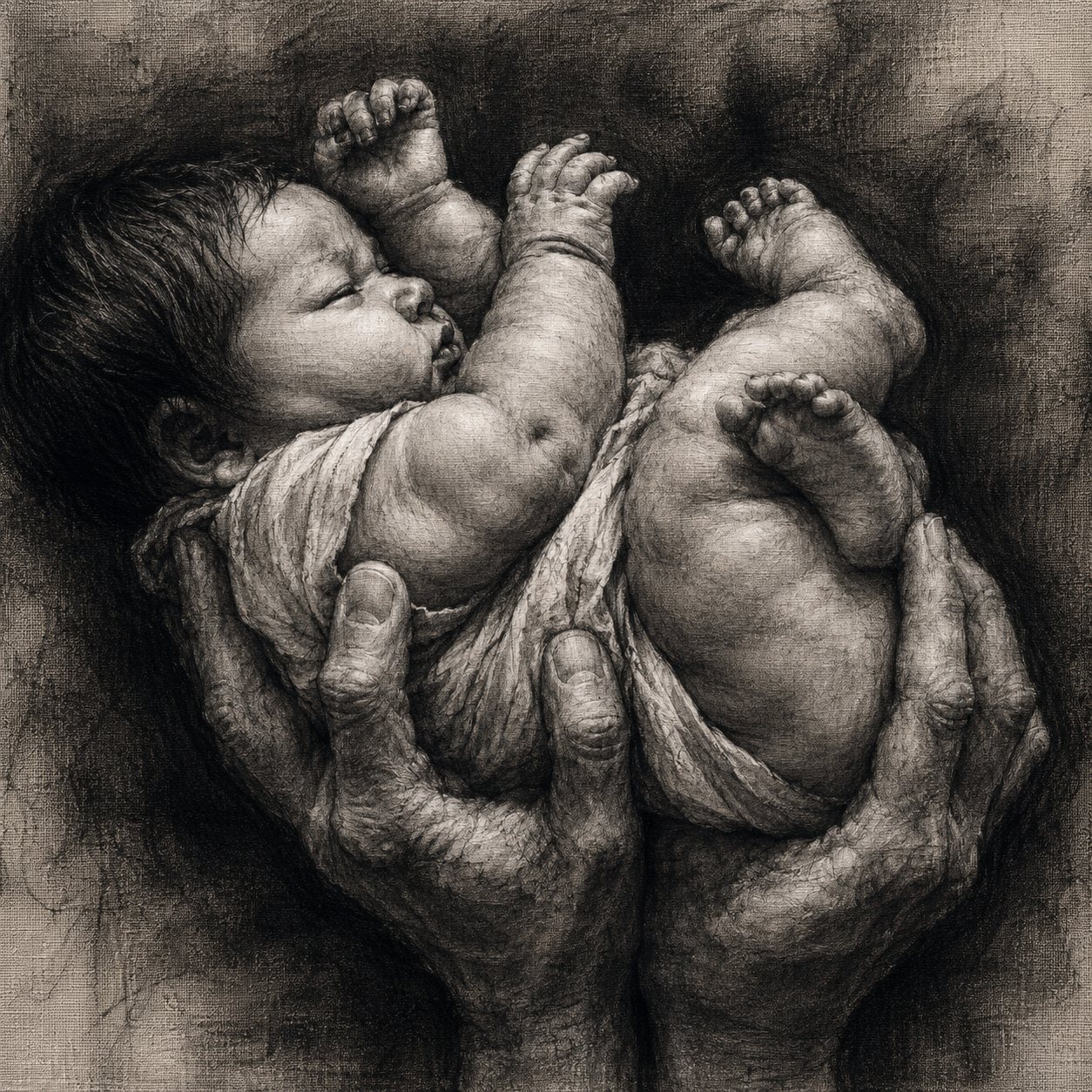
THIS IS A WORK OF FICTION
The first ten-kilo baby was born during a power cut, which seemed important later, though at the time nothing in Calcutta felt complete without one.
Rain had been sulking over the city all afternoon. It had not fallen properly, only threatened, sweating from the sky and gathering in the backs of necks, in the collars of shirts, in the underarms of nurses hurrying through the dim corridors of Matri Sadan Nursing Home. Outside, on the lane off Chetla Road, a tea stall leaned into traffic like an old gossip. Men stood under a blue tarpaulin drinking tea from small glass cups, arguing about the price of onions, the uselessness of graduates, the new gated tower rising where the Mukherjee mansion had once collapsed into polite ruin.
A delivery rider in a wet helmet waited beside the pharmacy next door. Two political posters flapped against a wall, both promising dignity to people who had long ago learned to bring their own.
Inside the labour room, dignity had boiled away.
“Madam,” said Sister Ruma, “this child is not coming normally.”
Dr. Nandini Sen already knew. The mother, Piyali, a twenty-two-year-old housewife from Behala who had spent the past eight months being told by everyone older than her that pregnancy was not illness and therefore should be endured silently, had stopped screaming. That frightened Nandini more than the screaming.
The foetal heartbeat filled the battery-powered Doppler in a fast, wet gallop.
“Prepare theatre,” Nandini said.
“The generator?”
“Ask them to start it.”
“Diesel finished.”
Of course it was. In Calcutta, catastrophe often arrived not as thunder but as a man forgetting diesel.
They cut by torchlight.
Ruma held the light from her own phone until Nandini snapped, “Not there, not in my eyes,” and then apologized without saying the word. The anesthetist muttered steadily. Rain began at last, with the nasty confidence of something that had taken its time. Water hammered the tin shade outside the theatre window. Somewhere downstairs, someone shouted for the security guard.
When Nandini lifted the child out, the room changed.
It was not only large. Large would have been a relief, something to enter into a case sheet with a term like macrosomia and a note about maternal sugar. This child seemed completed beyond birth. His shoulders were thick, his arms pleated with fat, his thighs round as festival drums. His face was swollen but calm, with eyes open. Newborn eyes usually wandered in their private blue darkness. This one looked directly at Nandini.
“Weight,” she said.
Ruma took the baby, grunting. The scale was old, enamel chipped, purchased second-hand from a clinic in Tollygunge. It had measured thousands of ordinary beginnings.
The needle swung.
“Ten point two,” Ruma whispered.
“What?”
“Ten point two kilos.”
For a moment no one spoke. Even the rain seemed to listen at the windows.
Then the baby opened his mouth and cried.
It was not loud. That was the worst of it. It was thin and patient, like someone asking for a debt to be acknowledged.
By morning, the lane knew.
The tea stall knew first, then the ayahs, then the pharmacy, then the mothers-in-law seated on plastic chairs outside the wards, each holding a cloth bag of fruit and judgment. By ten, the para had embroidered the fact into splendour. The child was twelve kilos, fifteen kilos, born with teeth, born smiling, born saying Ma in a baritone voice. A man from a cheap Bengali news channel arrived and was denied entry, so he filmed the nursing home signboard and said, with appropriate sorrow, that modern food habits were destroying mothers.
Piyali’s husband did not look destroyed. He looked dazed, almost proud.
“My son is strong,” he said, standing near the billing counter with his shirt damp and his hair carefully oiled.
“Your son is in danger,” Nandini said.
He blinked. Pride, in Bengal, is often the first cousin of panic.
“What danger?”
“We need to transfer him to a bigger hospital. Neonatal intensive care. Tests.”
“How much?”
There it was. The true vital sign. Not pulse. Not pressure. Cost.
Nandini looked at him and saw the calculation begin its miserable little arithmetic. Taxi, bed charge, blood tests, lost workdays, food for relatives waiting outside, nurse tips, medicines not available in hospital pharmacy, shame borrowed from cousins.
“We’ll arrange,” she said, though she had no power to arrange anything except signatures and small lies.
The baby gained six hundred grams before noon.
Ruma weighed him twice. Then on another scale. Then with herself holding him, subtracting her own weight, because old Calcutta still trusted bodily inconvenience more than instruments.
“Madam,” she said, “he is eating nothing.”
“Breastfeeding?”
“Trying. Poor mother is crying. He latches, then sleeps. Still weight increasing.”
Nandini went to the room.
Piyali lay sideways, pale and furious, the way exhausted women become when the world has congratulated everyone except them. Her son slept beside her in a metal cot too small for him. His cheeks pressed outward. His fists opened and closed slowly.
“My milk is not enough?” Piyali asked.
“It’s not that.”
“My mother-in-law says because I ate chow mein twice.”
“Your mother-in-law is not a medical authority.”
Piyali almost smiled, then winced. “Didi, take him away. I am afraid to sleep beside him.”
The baby’s eyes opened again.
Nandini felt, absurdly, that he had waited for that sentence.
By the third day there were four of them.
Two born in government hospitals. One in a private clinic near Bansdroni. One in Matri Sadan again, this time to a schoolteacher named Madhumita who had done everything correctly: iron tablets, calcium tablets, two ultrasounds, no papaya, no lifting buckets, no arguing with husband during eclipses. Her baby girl weighed nine point eight kilos and split the skin of both her shoulders during delivery before they converted to surgery.
The city acquired a new whisper.
At first it was diabetes. Then hormones in chicken. Then pesticides. Then mobile towers. Then divine anger. Every crisis in Calcutta must pass, like a tram through old tracks, through science, superstition, politics, and someone’s uncle who knows a doctor in Vellore.
Nandini made a list.
She did not tell anyone about the list.
She wrote the mothers’ names in a ruled notebook she had bought from a stationery shop near Kalighat metro, beside stacks of coaching centre guides promising government jobs to boys with defeated eyes.
Piyali Das. Behala. First pregnancy. No diabetes. Took Supramatrin Gold.
Madhumita Roy. Bansdroni. First pregnancy. No diabetes. Took Supramatrin Gold.
Nusrat Jahan. Garden Reach. Second pregnancy. Mild anaemia. Took Supramatrin Gold.
Farida Khatun. Metiabruz. First pregnancy. Took Supramatrin Gold.
The same strip. Same red-and-yellow packaging. Same smiling cartoon mother holding a baby shaped like a mango.
Supramatrin Gold was not gold, of course. Nothing with gold in its name ever was, except the metal itself and even that had become mostly a way for families to measure daughters against cupboards. It was a cheap prenatal vitamin: iron, folic acid, calcium, B-complex, iodine, zinc, a few fashionable additions in microscopic quantities, sold hard to nursing homes because it was affordable and therefore moral.
Nandini had prescribed it for nine months.
Not only prescribed. Recommended. Preferred.
The company representative, a cheerful man named Tapas with a tie too shiny for daylight, had come every Thursday with samples, pens, prescription pads, and the kind of humility that expected business. He had said, “Madam, poor patients can also get premium care.” He had left boxes. Later, envelopes.
Not large envelopes. Nandini was not a villain in a film. She had not purchased a flat in New Town from vitamin money. She had paid her father’s physiotherapy bill. She had repaired the nursing home autoclave once when the owner delayed. She had bought groceries without checking her bank balance and felt, for three hours, like a citizen.
Respectability in the city had become a stage performance with unpaid actors. Everyone knew where money came from, but only vulgar people mentioned the wings.
On Friday evening, Tapas came.
He arrived as rainwater gurgled through the lane drains and a tram bell sounded from the main road, faint and stubborn as an old idea. The pharmacy shutters were half down. The tea stall’s radio played a song from a film everyone pretended not to like. Tapas stood under the awning with his sample bag held to his chest.
“Madam, difficult time,” he said.
“Come inside.”
He did not want to. That was clear. Men like Tapas preferred corridors, reception desks, moving conversations. Rooms with doors made them honest.
In her consultation chamber, beneath a framed picture of a pink baby sleeping in impossible cleanliness, Nandini placed four strips of Supramatrin Gold on the table.
“Batch number,” she said.
He looked.
“Same batch,” he said too quickly.
“I know.”
“Coincidence can happen.”
“Four ten-kilo newborns in one week?”
“Media exaggeration.”
“I delivered two.”
Tapas sat down. The chair sighed.
“Madam, I am small person. Sales only.”
“Who manufactures it?”
“Listed on packet.”
“The packet says Shakti Nutraceuticals, Dankuni. I called. The number is dead.”
He wiped his forehead.
“Sometimes outsourcing happens.”
“To whom?”
He looked at the door.
“Tapas.”
“My job will go.”
“Children are growing inside cots.”
He flinched at that. Good, she thought. Let there be at least one nerve left in commerce.
He opened his bag and removed a folder, then closed it again. “There was a change in formulation. New growth complex. Company said very safe.”
“What growth complex?”
“Natural.”
“Arsenic is natural.”
He gave a miserable laugh. “Madam, please.”
“What is in it?”
“I don’t know.”
“Where is it made?”
He stared at the strips. His voice dropped.
“Old cold storage near Tangra. Behind the leather godown. Night production. I never went inside.”
“Why night?”
Now his fear became irritation, which was fear wearing shoes.
“Because everything in this city happens at night if it cannot survive daylight.”
That was the first true thing he had said.
At midnight, Nandini went to see Piyali’s child.
The ward was dim. A backup bulb burned near the nurses’ station. Someone’s mother snored with heroic openness on a bench. Rain tapped against the balcony grille. From far away came the announcement of a metro train, blurred by wet air, the city speaking to itself underground.
The baby was awake.
He no longer fit the cot. His legs pressed against the rails. His stomach rose under the hospital sheet like dough proving.
Piyali sat beside him, staring.
“He is heavier,” she said.
“Yes.”
“I dreamed he was eating the room.”
Nandini touched the baby’s foot. Warm. Smooth. Swollen. The skin did not pit under pressure. This was not oedema. Not fat exactly. It had the dense, wrong resistance of something packed.
The baby turned his head.
His mouth opened.
At first Nandini thought he was yawning. Then she heard the sound.
Not a cry. Not breathing.
A faint sucking.
The sheet trembled. A corner lifted, slid toward his lips, and stuck there, darkening with saliva.
Piyali whispered, “He does that.”
“To cloth?”
“To everything.”
The metal rail gave a soft click.
Nandini pulled the sheet away. The baby’s lips closed. His eyes remained fixed on hers, calm, almost bored.
By the next morning, he weighed fourteen kilos.
The hospital agreed to transfer him only after Nandini used the private number of a senior pediatrician who owed her no favour but had once liked her in medical college. An ambulance came late. Piyali’s husband shouted about bills. Piyali said nothing. As the child was lifted, one of the ayahs crossed herself, though she was Hindu, then looked embarrassed by her own hand.
Before the ambulance left, Nandini did something she had not planned.
She took one strip of Supramatrin Gold from her drawer and swallowed a tablet.
It was stupid. She knew that while doing it. Doctors are not immune to stupidity; they merely use better vocabulary while sinking.
The tablet tasted metallic and sweet.
Ruma saw.
“Madam?”
“I need to know.”
“You need sleep.”
“I need evidence.”
“You need God.”
“No. I need pathology.”
Ruma’s face hardened in the way of practical women when educated people become dangerous. “Same thing, some days.”
By evening, Nandini was hungry.
Not ordinary hunger, not the elegant emptiness of missed lunch. This was architectural. It had rooms. It moved through her body opening doors. She ate two egg rolls from the corner shop, then muri, then bananas meant for patients, then glucose biscuits from Ruma’s tin. At ten she drank water from the steel jug and felt no fullness. Only a sense of being delayed.
At eleven, her abdomen cramped.
She locked herself in the staff toilet and vomited into the basin.
What came out was not food.
It was grey paste, thick as wet cement, threaded with something red and shining. It smelled faintly of iron tablets and pond water. For one wild second she thought it moved.
Then the lights went out.
In the darkness, from the basin, came the patient sucking sound.
Nandini ran.
She reached Tangra the next afternoon with Ruma beside her, because Ruma had refused to be left behind.
“You will go alone and die scientifically,” she said. “I will come and die practically.”
The old cold storage stood behind a lane where goats nosed at plastic and restaurant waste steamed in the heat. Tangra had always smelled of several histories at once: leather, garlic, drains, frying oil, wet brick, money changing hands invisibly. A Chinese signboard, faded to pink, hung over a locked gate. Beyond it, a warehouse squatted under black rainclouds.
No guard stopped them. That was the first bad sign.
Inside, the air was cold.
Not air-conditioned cold. Buried cold.
They found cartons of Supramatrin Gold stacked under tarpaulin. Machines stood idle, their metal mouths stained orange. On a table lay sacks labelled as mineral premix. The labels had been pasted over older markings. Ruma peeled one back.
Underneath, in English and Bengali, were municipal disposal tags.
Placental tissue. Biomedical waste. Incineration required.
Ruma stepped away.
Nandini felt the room bend slightly.
There were barrels at the back, sealed with blue lids. One had cracked. Grey paste had dried along its side in ridges like old wax. Beside the barrels lay a small shrine: marigold husks, incense ash, a clay bowl, and a framed print of Shashti, protector of children, her cat crouched beneath her. Someone had garlanded the goddess with empty blister packs.
On the wall, written in red powder, were three words.
FEED WHAT COMES.
Ruma said, “Madam, we should leave.”
A sound answered her.
From behind the stacked cartons came a shifting. Slow. Heavy. Not footsteps.
They moved around the cartons.
Tapas was there.
He sat against the wall, shirt torn open, belly distended, face grey with sweat. His sample bag lay beside him. Around his mouth was the same grey paste. His eyes rolled toward Nandini.
“Madam,” he whispered.
“What happened?”
“They said waste should not be waste. So much birth material. So much strength thrown away. They made extract.” He swallowed. “Mothers want big healthy babies. Doctors want cheap. Company wants margin. Goddess wants—”
His body tightened.
Under his skin, something passed across his abdomen, a slow bulge like a fist beneath cloth.
Ruma grabbed Nandini’s arm.
Tapas began to laugh. It was not joy. It was surprise.
“Not vitamin,” he said. “Prasad.”
His stomach split without drama, like an overripe fruit giving up.
Ruma screamed once. Nandini did not. She watched the grey mass inside him open several small mouths.
Then the cold room filled with crying.
Not from Tapas.
From the cartons.
Every sealed box began to tremble.
They ran.
Outside, rain had started again, thick and warm. A taxi refused them because Ruma had blood on her sari. They walked until they found an auto. The driver looked at them in the mirror and decided, wisely, not to ask.
That night the news broke properly.
Not because of Nandini. She called three authorities and was transferred, doubted, advised, and finally asked to send an email. Ruma called her cousin, whose neighbour knew a journalist with no money and therefore some appetite for truth.
By midnight, police had sealed the Tangra unit. By morning, the company denied all association. By afternoon, the state promised an inquiry. By evening, opposition leaders arrived with microphones. By night, a rumour spread that foreign agencies were sterilizing Indian mothers by making their babies too large to bear.
Meanwhile, the children kept growing.
Piyali’s son reached twenty-two kilos in six days.
His mother stopped producing milk and began losing weight so rapidly that her bangles slipped from her wrists. The baby did not need feeding now. He absorbed. Cloth, gauze, plaster, the vinyl cover of his hospital mattress, the wooden edge of a visitor’s chair. Once, a nurse placed her hand too close and lost the nail of her index finger without pain, as if it had been politely erased.
Madhumita’s daughter did not cry at all. She lay in an incubator she had already cracked and stared upward. Her weight climbed by the hour. When her father recited multiplication tables beside her, perhaps out of habit, perhaps because schoolteachers believe numbers can discipline the universe, the monitor flickered and died.
Nandini was suspended.
The owner of Matri Sadan said it was temporary. The medical association said due process. The mothers’ families said murderer. She did not disagree with them.
She sat in her flat near Lake Gardens while rain filled the balcony cracks and pigeons sheltered under the AC ledge. Her father’s old chair stood by the window, empty now. He had died in February after three years of being kept alive by bills, tubes, and her stubborn refusal to admit that love sometimes becomes a machine for prolonging departure.
On the table lay the notebook.
Names. Dates. Batch numbers. Outcomes.
At the bottom she wrote one sentence: I prescribed hunger to the unborn.
The doorbell rang at dusk.
Ruma stood outside holding a cloth bundle.
“No,” Nandini said.
“Listen first.”
“No.”
“Piyali is dead.”
The hallway seemed to lengthen.
“When?”
“Afternoon. Her body just… finished. Husband ran away. Mother-in-law says curse. Hospital says septic complication. Baby is missing.”
“Missing?”
Ruma lifted the bundle.
Inside lay a blister strip of Supramatrin Gold. Empty.
“I found this under Piyali’s pillow. She was taking it after delivery also.”
“Why?”
“She said if the baby was hungry, mother should be bigger.”
Nandini closed her eyes.
The city outside went briefly silent, as if between two breaths of rain.
Then, from the stairwell below, came a sound.
A soft dragging.
Ruma turned.
The building lights flickered. Somewhere a pressure cooker whistled in another flat, ordinary life performing its insulting little music. A child laughed from a television. Water dripped down the stairwell.
Drag.
Pause.
Drag.
Nandini opened her door wider.
On the landing below, in the weak emergency light, something pale moved upward.
It was not Piyali’s son. Not exactly.
He had grown too large for the name baby, too soft for the name child. His limbs folded under him. His face remained infant, round and solemn, but stretched across a mass that filled the width of the stairs. The iron railing bowed inward where his shoulder pressed it. His mouth worked gently against the concrete step.
Where his lips touched, cement vanished.
Ruma made a small broken sound.
The child looked up at Nandini.
Recognition passed between them.
Then Nandini saw what she had missed from the beginning. The children were not growing because they were hungry. They were hungry because they had been made to grow. The tablet had not fed them. It had given them the first instruction any city understood perfectly: take more space, take it quietly, and call it development.
Behind the child, lower in the stairwell, came another sound. Then another.
Many soft bodies climbing.
Nandini stepped back into her flat. Ruma whispered her name.
On the table, beside the notebook, the remaining strip of Supramatrin Gold lay in the dark like a row of tiny sealed rooms.
Nandini picked it up. Not to destroy it. She understood that now. Destruction had been the first superstition. Fire would feed them. Burial would feed them. Denial already had.
She placed one tablet on her tongue and swallowed.
The child on the stairs stopped climbing.
For the first time since birth, his face changed.
He smiled, relieved, as if his mother had finally come home.